10 minutes
Powering my Homelab from Microsolar
☀️💻 Offsetting my Homelab Cost With Solar
My homelab draws roughly 250–350W continuously - a few servers, one NAS, switches, and a UPS on standby. That adds up to around 240 kWh per month or £44 on the electricity bill. It is a noticeable amount, especially as energy prices are predicted to continue rising and my homelab endeavour started several years ago with the intent on reducing my cloud storage cost.
Microsolar (sometimes called balcony solar or plug-in solar) was a pretty low-commitment way to dip into renewables without a full roof installation (I plan on moving soon).
I spent a long time researching online, about whether it was possible electrically, financially viable, what components were needed etc.
I decided on a basic 800W inverter with two panels. I did consider putting them on the roof but as it’s slate, and cost was a big factor for me, I opted to build a basic ground mount.
This system will be grid-tied (i.e. will not run without a connection to the grid).
Kit I Purchased
I originally purchased a Hoymiles Inverter which was a mistake: requiring an additional Data Transfer Unit at the same price as the inverter just to be able to communicate with it, the technology behind it was clunky; the app required being invited for login to work. I felt it was a pretty useless piece of kit.
So I ended up with:
- 2x DMEGC 465W Panels - £73.68 x2 = £147.36
- Ecoflow Stream Microinverter - £99
Sub-Total: £246.36
Panel Compatibility with the Ecoflow
I needed to ensure panel compatibility with the Ecoflow. The inverter has a max input voltage of 65V DC per MPPT channel (and it has two channels). It also has a maximum of 600W input per channel.
As the temperature falls, the resistance falls so the panel output increases (for a given solar input). So we need to make sure the panels will be safe given the lowest worst-case temperature which I’ve chosen to be -10°C in Somerset.
To do this, we need to calculate the Open Circuit Voltage (Voc) using:
$$V_{oc}(T) = V_{oc}(STC) \times \left(1 + \frac{\beta}{100} \times (T_{cell} - 25)\right)$$
Where:
- $V_{oc}(STC)$ is the open circuit voltage at Standard Test Conditions (25°C) — 36.46 V for my panels
- $\beta$ is the temperature coefficient for Voc — −0.25 %/°C for my panels
- $T_{cell}$ is the worst-case cell temperature — −10°C for Somerset
$$V_{oc}(-10°C) = 36.46 \times \left(1 + \frac{-0.25}{100} \times (-10 - 25)\right) = 36.46 \times 1.0875 \approx 39.65\text{ V}$$
39.65 V is well below the 65 V maximum input of the Ecoflow inverter. And for maximum power output:
$$P_{max}(T) = P_{max}(STC) \times \left(1 + \frac{\gamma}{100} \times (T_{cell} - 25)\right)$$
$$P_{max}(-10°C) = 465 \times \left(1 + \frac{-0.29}{100} \times (-10 - 25)\right) = 465 \times 1.1015 \approx 512\text{ W}$$
512 W is also comfortably below the 600 W per channel maximum. We’re good.
(There’s also a useful calculator here I used. I retrieved the necessary data on temperature from the MetOffice and on the panels from the technical specifications they shipped with)
In addition, I got some peripherals to build a basic ground-mount:
- 8x C16 CLS timber to build a corner frame to sit in my garden - £28.80
- Fastensol Mounting Rail - £17.57
- Clamps (Mid and End) - £7.20
Sub-Total: £53.57
Total: £299.93
Building It
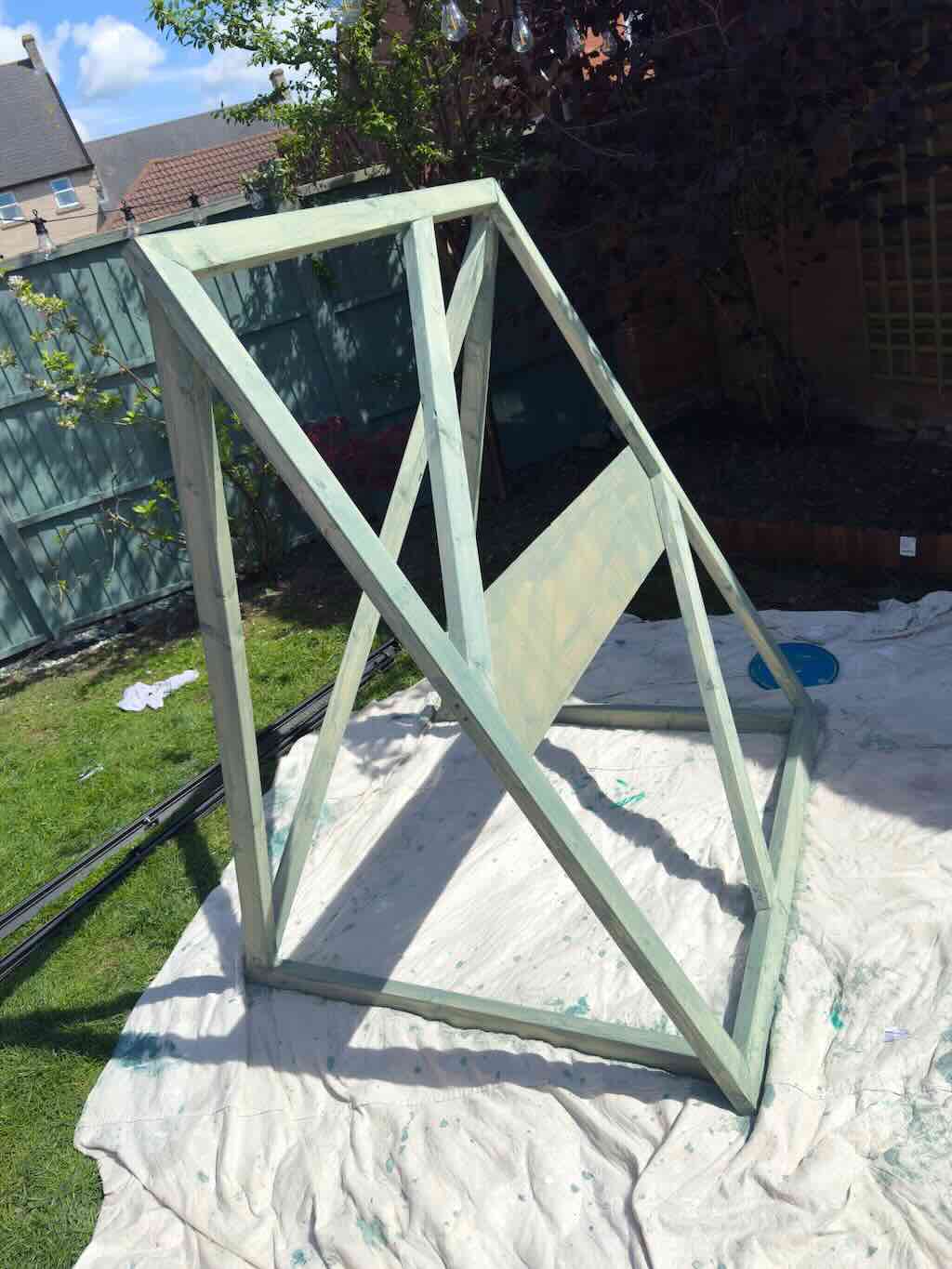
After deciding the roof was a no-go, I put together a fairly rudimentary frame out of some timber, attached the mounting poles to it and then clamped the panels on. The frame is at 60°, not the ideal 45° for solar, but it fitted in my garden better at this angle.
The inverter comes with 4x MC4 extension leads (which turned out to be unnecessary) and the grid cable which has a Ecoflow inverter connector on one end, and Live/Neutral/Earth (LNE) on the other.
Wiring it In
Wiring the panels into the inverter is, of course, easy. Plug in the MC4 connectors whilst making sure the inverter is disconnected and you’re in.
Wiring into the house was more tricky. Right now today, plug-in solar is not legal in the UK as it’s not compliant with either G98 or BS 7671.
I’d planned on using an unused circuit that terminates at a fusebox in my garage for the input. The day after I ordered the kit for this, the government announced they were making plug-in solar available within months.
However, given I already had a spare circuit with a bi-directional double-pole Type A RCBO / RCD in and the necessary other components to wire in solar, I got my friendly electrician to wire in the Ecoflow LNE to the circuit and start generating. Because we’re mates, he did this for free which is a situation not many people find themselves in. (Directionality in RCBOs is stupid given it’s alternating current, but some genius introduced it presumably to get more money from consumers.)
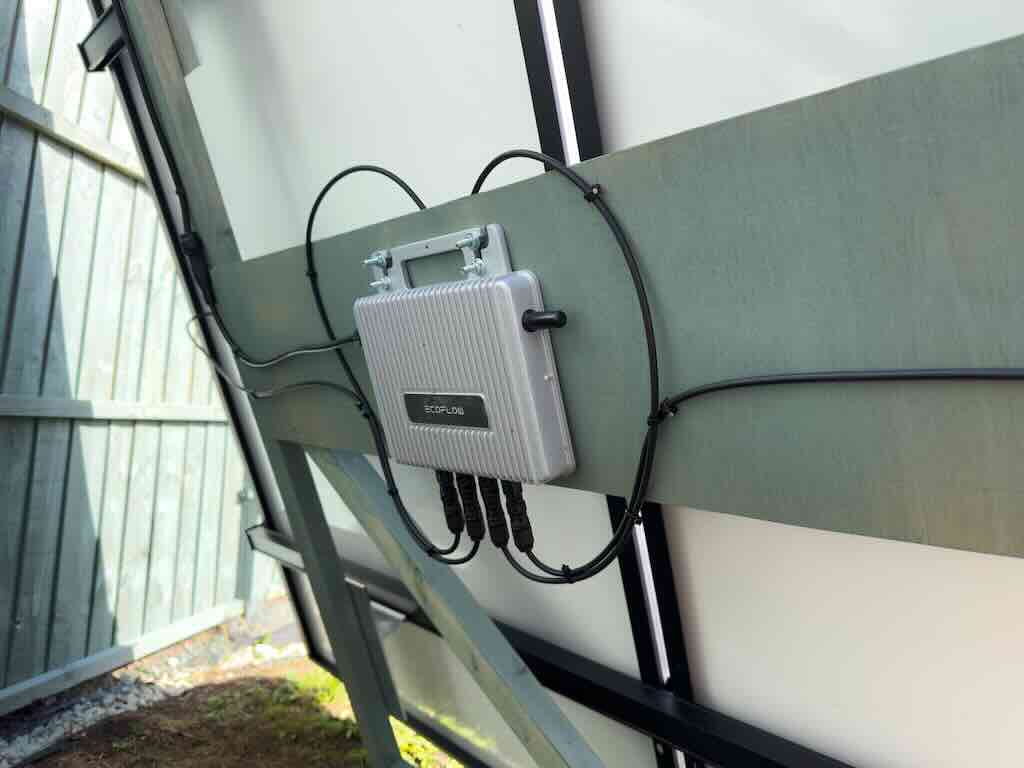
Because of that last-mile connection to the house (which would have cost at least the panels and inverter over again), plug-in solar is a gamechanger. As a test, the electrician wired up a socket to the Ecoflow LNE and plugged it in - worked fine. Started generating without any issues. I have a bi-directional Type A RCBO on the circuit, so this made the setup totally safe.
Most people don’t happen to have a spare circuit in their garage, and the cost of installing one easily changes payback for this system from one year to five. So, the availability of plug-in solar will make this an eminently feasible option for anyone with a reasonable baseload.
In a few months, this will be achievable simply by connecting that LNE to a plug and plugging that in to a socket. Easy peasy.
G98 Application
My electrician friend submitted this for me, but I still haven’t been able to get paid for any exports yet, so all the calculations below don’t account for export pay.
When I run the model with the £0.12 export payments it only nets me £16 a year so the paperwork really isn’t worth the hassle.
Projected Generation vs Consumption
In order to project whether this was worth it before purchasing, Claude and I built https://github.com/ben-freke/solar-model, a basic modelling tool using PVGIS to predict just how much I’d make back.
I used an iOS tool to create a horizon profile I could submit for improved accuracy in the model.
The chart below shows the estimated monthly solar output for an 800W system in southern England against the homelab’s flat ~240 kWh/month draw (£44/month).
Peak summer months (June–August) get close to 120 kWh — about half of what the homelab needs. The annual total comes to roughly 966 kWh generated (832 kWh self-use + 134 kWh exported), against ~2,880 kWh consumed. That’s around a 33% offset. Since all of the self-use displaces peak-rate imports (28p/kWh), savings work out to roughly £233/year with exports uncounted. Payback on the £300 hardware lands at about 15–16 months — insane if true, as the payback for some solar systems is into multiple decades.
What I Actually Observed
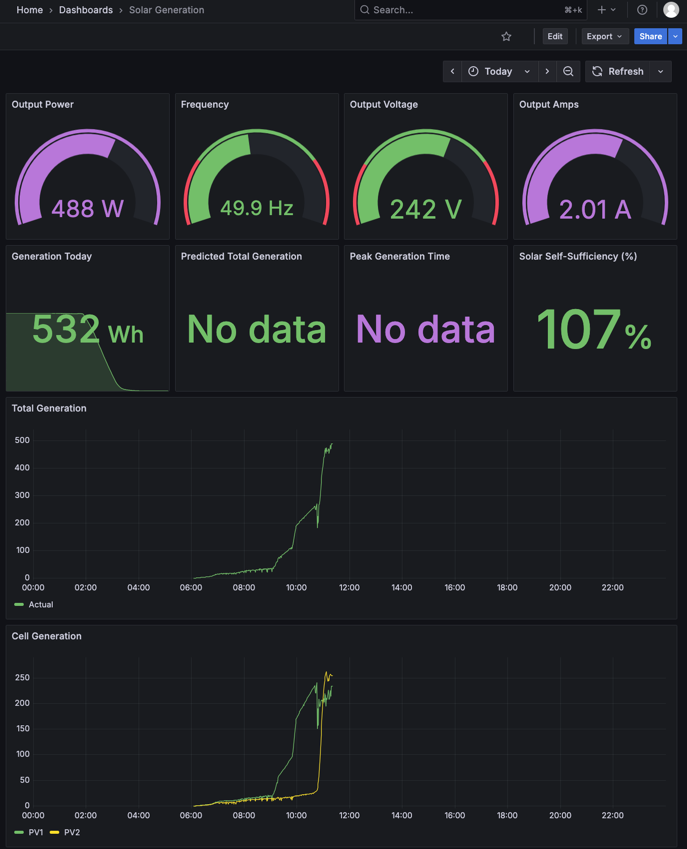
In practice the numbers track fairly well. The micro-inverter reports live generation over BLE. This is connected to Home Assistant, then exported to Prometheus and displayed in Grafana, so I can correlate it against Home Assistant’s energy dashboard.
A clear May day produces 3–4 kWh; an overcast January day might manage 0.3 kWh. The homelab’s consumption is predictably flat.
(The forecasting is a bit more troublesome with Grafana / Prometheus forecasting, so currently shows no data. To fix later…)
Example Daily Usage
The chart below shows an example day in April that shows generation, homelab consumption and my energy prices. You can see that a good chunk of the higher day prices are covered by the solar now.
Annual Generation & Savings
In fact, the predictions indicate I’ll generate 966 kWh over the year, which offsets about 33% of the ~2,880 kWh of yearly homelab use. However, because generation lines up almost entirely with the peak-rate window (28p/kWh vs 4p/kWh overnight), each self-used kWh displaces an expensive import. Self-use at 832 kWh × 28p nets me around £233 per year — the 134 kWh of exports are worth a further £16 on paper but I’m not being paid for them yet.
Is It Worth It?
For a homelab specifically — yes. The load is constant, predictable, and runs 24/7, which means any solar generation directly displaces grid draw rather than going to waste.
A battery would improve the overnight story but roughly doubles the cost and complexity; I’ll revisit that if generation data after a full year makes the case. My current modelling shows a 10-year payback period to add a 2kWh battery (DJI Power 2000 for example). I’m not sure if this is worth it, but the off-grid support is attractive.
If you’re already on a time-of-use tariff (Octopus Agile, for example) the maths shift further — generating during peak-rate hours and consuming cheap overnight power is a meaningful additional gain.
Everything in this post is just my own experience — stuff I figured out, got wrong, and eventually got right. Please don’t treat any of it as instructions or professional advice. If you’re doing anything electrical, please consult a qualified electrician like I did — it’s genuinely worth it.